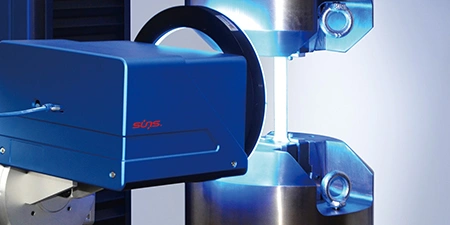
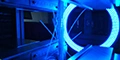
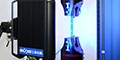
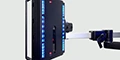
Video Extensometer / Digital Image Correlation (DIC) System
Video extensometers use monocular 3D digital image correlation (DIC) to measure deformation without touching the specimen. During tensile, compression, bending, torsion, fatigue, and impact tests, a camera records images as the testing machine applies the load. The DIC software compares these images and calculates three-dimensional displacement and strain across the specimen’s visible surface in real time.
Available Specifications
| Models | GB-S-160A, UK200, UK70, and BK80 |
| Accuracy class | Class 0.5 |
| Measurement accuracy | ±1.5 μm |
| Displacement resolution | 0.1 μm |
| Image resolution | 11 megapixels |
| Image capture rate | 30 Hz |
| Measurement area | approximately 160 × 110 mm (longitudinal × transverse) |
| Working distance | approximately 200 mm |
| Tracking speed | 0.05–1000 mm/min |
| Strain measurement range | 0.005%–2000% |
| Specimen temperature range for measurement | −190°C to 2300°C |
| Communication | digital signal through the UDP protocol |
| Standard measurement environment | room temperature |
| Equipment operating temperature | 5–40°C |
| Power supply | 220 V |
| Main unit weight | 450 kg |
Features
- The software combines the point-cloud data from multiple cameras to create a single 3D view of the specimen
- Users can export the point-cloud data for comparison with CAD models
- Analysis tools compare the DIC measurements with simulation results from Abaqus ODB files
- Temperature-field measurement adds temperature data to the deformation analysis
- An integrated laser rangefinder quickly checks the distance between the camera and the specimen
- Temperature sensors and controls compensate for measurement errors caused by changes in the unit’s temperature
- Integrated lighting produces an even, rectangular light field across the measurement area
- The position sensor compensates for errors when the measuring unit shifts or changes angle.
- Virtual strain gauges measure deformation and return the results in real time