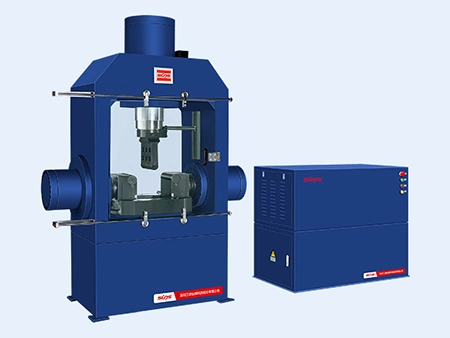
Bending Testing Machine / Flexure Testing Machine
Applicable Standards
- GB/T 232, GB/T 15825.5, ISO 7438, ASTM E290, DIN EN ISO 178
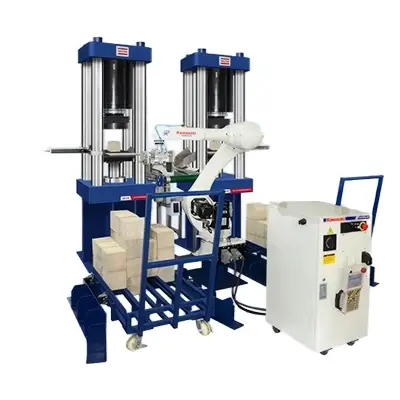
Bending testing machines, also known as flexure testing machines, show how a specimen responds when force causes it to bend. The specimen rests on two supports, and the load is applied through one or two contact points according to the selected test method. The bend tester records the applied force and resulting deflection to determine properties such as bending strength and flexural modulus or to check if the specimen completes a specified bend without cracking.
Specifications
| MODEL | | | |
| Max. Test Force (kN) | 500 | 1,000 | 2,000 |
| Max. Horizontal Load Force (kN) | 400 | 1,000 | |
| Accuracy | Class 0.5 | ||
| Rollers (mm) | ⌀50×200 | ⌀80×210 | |
| Mandrels (mm) | 1-⌀200 | ||
| Specimen Thickness (mm) | 40 | ||
| Vertical Loading Speed (mm/min) | 100 | 200 | |
| Horizontal Loading Speed (mm/min) | 240 | 150 | |
| Main Ram Stroke (mm) | 320 | 340 | 350 |
| Support Span (mm) | 360 | ||
| Frame Dimension (mm) | 1,580×600×2,200 | 1,660×600×2,300 | |
| HPU Dimension (mm) | 1,200×600×1,150 | ||
| Power (kW) | 7.5kW(380V)+2kW(220V) | ||
| Weight (kg) | 2,800 | 4,200 | |
Features
- Bending testers are available in 500 kN, 1000 kN, and 2000 kN capacities to cover different specimen sizes and force requirements.
- The three hydraulic cylinders move together throughout the bending test, while the control system monitors the displacement of each cylinder and keeps the synchronization error within ≤2%.
- Operators may control the bending test manually or select an automatic program. Once started, the automatic mode follows the preset steps, records the measurements, and calculates results such as bending strength and elastic modulus.
- Different fixtures support three-point, four-point, 180°, and custom-angle bending tests on metal plates and bars up to 40 mm thick.
- Optional fixtures provide the setup required for bending tests on composite materials.
- The low-noise hydraulic unit adjusts its power output to the test load, which reduces noise and unnecessary energy use.
- Multiple travel limits and overload protection help prevent damage to the specimen and bending tester.
- Thanks to their compact frame, these bend testers save floor space, and the control interface which is easy to access makes operation and maintenance simpler.
Applications
Bending testing machines are used for material evaluation and quality inspection across several industrial fields, including:
- Bend testing of hot-rolled and cold-rolled steel plates
- Quality inspection of steel and aluminum alloy bars
- Evaluation of structural metals used in aerospace components
- Testing of composite materials with optional fixtures
- Product development and production checks in metallurgy and machinery manufacturing
- Standardized testing by independent and government inspection laboratories