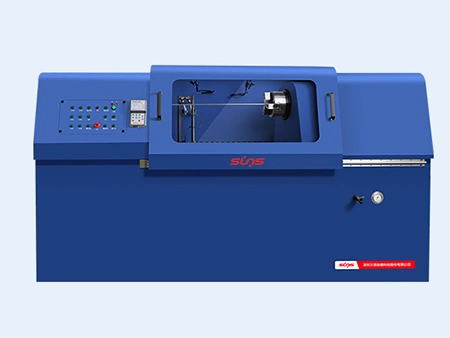
Torsion Test Machine (Variable Speed Rotation)
- GB/T 239.1, GB/T 239.2, GB/T 10128, GB/T 4909.4, JJG 269, YB/T 4176, HB 5174, GJB 715.14, GJB 715.15, ISO 9649, ISO 18338, ASTM E143-13
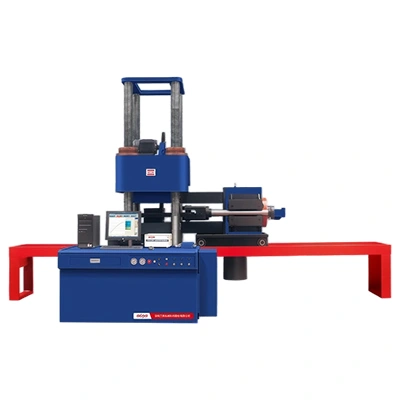
Our torsion test machines with variable-speed rotation were developed in collaboration with Baosteel Central Research Institute to support studies of the relationship between torsional behavior and microstructural changes in high-strength steel wires and wire rods used to produce stay cables for long-span cable-stayed bridges. They can also test other wires, rods, fasteners, and components at different speeds and in either direction of rotation. Operators set the rotation speed before starting each test, and the torque sensors record changes in torque as the specimens twist. Critical sampling provides a more detailed record of selected stages of the test. They are widely used in materials research, metallurgical quality inspection, fastener and automotive component testing, failure analysis, service-life studies, and university teaching.
| Accuracy | Grade 0.5 |
| Max. Torque | 1,000 Nm |
| Torque Measurement Range | 1–100% FS |
| Torque Indicated Relative Error | ±0.5% |
| Torsion Angle Measurement Range | 0°–10,000° |
| Torsion Angle Control Accuracy | 0.001° |
| Torsion Speed Range | 0.0005–30 r/min |
| Torsion Speed Relative Error | Within ±1.0% of set value |
| Applicable Specimen Diameter | ⌀2–⌀20 mm |
| Moving Distance Between Two Chucks | 100–1,000 mm |
| Motor Power | 5 kW |
| Power Supply | 380V±10% / 50Hz |
| Weight | Approx. 500 kg |
- Studies that relate the torsional behavior of high-strength steel wire and wire rod to changes in their microstructure, particularly for materials used to produce stay cables for long-span cable-stayed bridges
- Mechanical property evaluation during new material development, failure analysis, and service-life studies
- Quality inspection of wire, wire rod, and other metallurgical products
- Torsional strength tests on bolts and other fasteners, as well as torsion tests on automotive components
- Materials testing lessons and student experiments at universities
- Operators can adjust the rotation speed continuously from 0.0005 to 30 r/min, from very slow movement to higher-speed torsion tests.
- The servo motor and cycloidal pinwheel reducer transmit torque smoothly and maintain a steady rotational speed during the entire test.
- The actual torsion speed remains within ±1.0% of the set value, to ensure consistent test conditions.
- The high-precision torque sensor monitors the mechanical response of the specimen in real time.
- When the torque has reached its maximum and then dropped to the predetermined value, the controller stops the test and releases the load to protect both the specimen and the test components.
- Critical sampling involves collecting data at the point where fracture occurs to study the changes in microstructure that take place during large ductile deformation.
- The torque measurement range extends from 1% to 100% of full scale (FS), and the maximum torque is 1000 Nm when carrying out tests with higher loads.
- The tester measures rotation angles from 0° to 10,000° and offers angle control accuracy of up to 0.001°.
- The digital three-loop controller ensures that data collection remains stable and can quickly respond to any changes during the test.